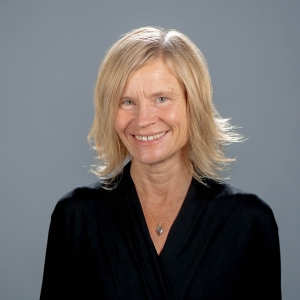
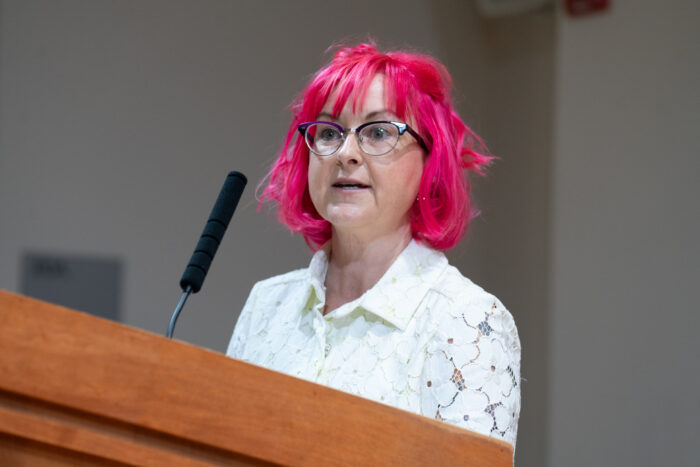
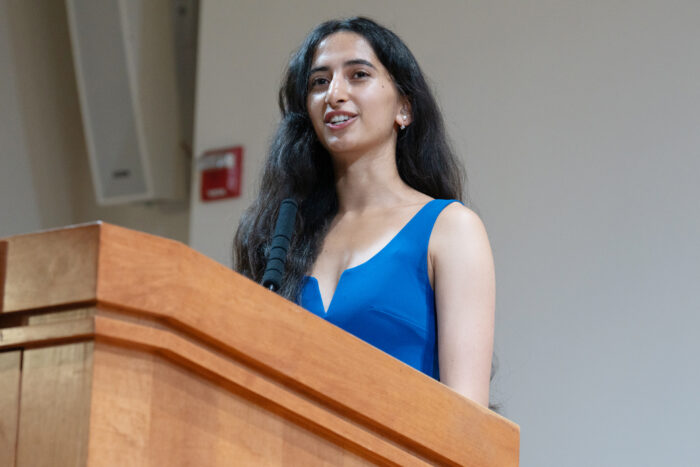
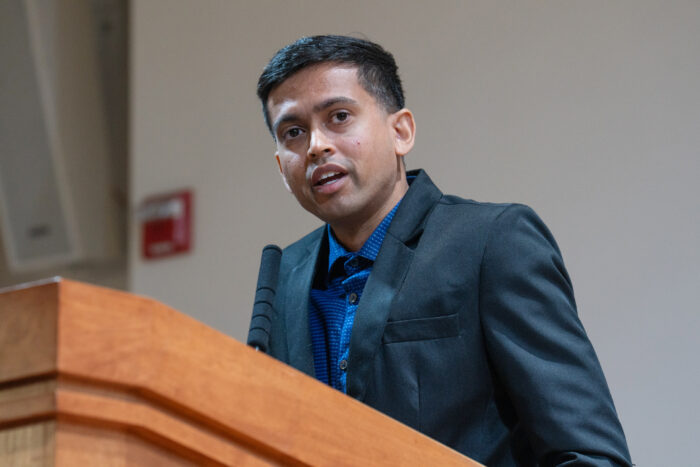
First-year Master of Development Engineering student Kemmy Rai grew up in Nepal knowing firsthand the impacts of natural disasters from flooding to earthquakes.

In August, flash floods swept through the country’s northern mountainous region, swallowing whole buildings and resulting in the death and disappearance of thousands of people.
Rai first found out about the floods in a LinkedIn post. She didn’t realize it was a glacier collapse and first thought it was the typical terrestrial flooding she grew up around.
Rai said her family wasn’t directly impacted, and she highlighted the anger and sadness people are feeling about the devastation.
“Because Nepal is one of the countries that contributes the least to greenhouse-gas emissions,” she said, noting the irony of the U.S. retreating from global climate initiatives.
Reporting by the BBC found that the high-altitude regions of the Himalayas are warming 50% faster than the global average and face increased natural disaster risks.
And according to data provided by Rai, the United States has emitted nearly a quarter of CO2 emissions since the Industrial Revolution.
She said that this cumulative emissions data matters because rising temperatures are the consequences of CO2 emitted over many decades. Despite being only 4% of the world population, the U.S. has been the top contributor to climate change.
The BBC also pointed to a collapsed glacier as a likely cause of the flash flood, though other factors could have also contributed. While Nepal contributes around 0.1% to global greenhouse gas emissions, the United States contributes around 11%, according to Climate Watch data.
Rai learned through news coverage following the floods how almost two years before the disaster, the U.S. had cut funding for an early warning system in the region.
CNN reported that the Trump administration cut funding for a natural hazards program called Project SERVIR-Hindu Kush Himalaya, which identified areas prone to landslides and other hazards that climate change is making more common.
The reporting noted that while that system wouldn’t have been able to warn of the glacier and rock landslide that occurred in August, as that type of disaster is rare, the program was working on spotting locations where similar events could likely occur. This in turn, could help communities downstream prepare.
Following the floods, experts say the region has a high need for better warning systems in a region that is challenging to monitor.
Rai recalled flooding being an issue beginning in 2010. Her house was one of the oldest houses in the Terai region, in southern Nepal, and was more susceptible to flooding than other homes.
“Our house was one of the old ones. And people started building next to it,” she said. “Houses were raised. Ours was a small one, and deeper. So the canal systems on the side of the roads would downpour into our house.”
She also experienced a devastating earthquake in 2015 that killed thousands.
“We were impacted on a livelihood basis, but not infrastructurally as much,” Rai said of her family. “We would just not stay at our homes. We would stay outside on the ground because of the high likelihood of aftershocks given the earthquake magnitude was 7.8.”
That experience, coupled with learning how vulnerable the building infrastructures in Nepal were, led her to pursue an associate’s degree in architecture at the College of San Mateo in 2018.
During the Covid-19 pandemic and the end of her architectural program, she dove into investigative documentaries and educational materials that deepened her understanding of other forms of injustice. Rai changed her major to English to inform people through storytelling and with a hope to provide a platform for “truths and stories that often get overlooked or unfairly manipulated.” She continued this journey by transferring to San Francisco State University’s Creative Writing Program.

Rai also received a certificate in climate change solutions and worked at several climate, environmental justice, and food system advocacy organizations before applying to the Master of Development Engineering program at UC Berkeley.
“At the time I was thinking about blending energy, water, environment, and AI/data analytics for social impact,” she said when she applied to the program.
Because she has an interdisciplinary and humanities-oriented background, she wanted to challenge herself and diversify her skills to “pursue or solve problems in whatever comes my way,” she said.
Nepal, however, is far from the only country affected by intense flooding. The Philippines is one of the most disaster-prone countries in the world — impacted by floods, landslides, typhoons, and earthquakes.
In September, the country experienced floods and landslides triggered by monsoon rains after four typhoons hit the country, killing dozens of people. This type of natural disaster is an annual occurrence in the country.

In response to the Philippines’ high disaster risk, second-year MDevEng student Noam Anglo, is collaborating with experts and people in the Philippines to innovate flood early-warning systems. While these systems are critical, maintaining flood sensors is costly and challenging, especially in remote and underserved areas.
Anglo was born in the Philippines and lived there for the first nine years of his life before moving to Canada. There, he studied mechanical engineering and worked as a robotics engineer after graduating.
“I loved the work… but after working in the field for a while, I felt like I wanted to make more of an impact with the skills I was gaining,” Anglo said. “I didn’t feel like the things I was working on were reaching the people that I wanted to reach.”
Anglo said his move to Canada from the Philippines highlighted the contrast of privilege in the global north.
“For most of my life, I’ve felt the obligation to use that privilege to help people,” he said.
Then he found the Master of Development Engineering program, which seemed like the perfect place to begin exploring what he should do with the resources at his disposal.
During his time at UC Berkeley, Anglo created BahaWatch, a flood monitoring project that came out of his DevEng C200 class and a conversation with Project NOAH, a leading research organization of disaster risk and climate science in the Philippines.
BahaWatch is an open, accessible, low-cost platform for flood sensing, Anglo said. It is composed of a network of wirelessly connected water level sensors and integrated through a dashboard accessible to researchers, local governments, community members, and more.
“Through the sensors, communities can monitor their local waterways for flood risk, while disaster risk management organizations can validate their models against a ground truth,” he said. “BahaWatch uses off-the-shelf electronics and locally available hardware to aid in maintenance and repairability.”
Anglo said that water level sensing has existed for decades, and BahaWatch is seeking to build on that technology, making it more accessible and maintainable. He spent several weeks in the Philippines over the summer, speaking to everyone he could about deploying sensor networks.
“Every single person, every agency said maintenance is our problem,” Anglo said. “Part of that is because it’s really hard to do. How do you maintain a sensor network at a place that is constantly getting flooded? And there are earthquakes. It’s hot so the batteries wore out, et cetera.”
The other part of the issue, he said, has to do with the priorities of the agency managing the sensors across different government administrations.
“The question that we’re asking at BahaWatch: How do we involve Philippine society, beyond the government, in developing, deploying, and maintaining these flood sensors in the places they are needed the most?” he said.
Anglo said he has a prototype of BahaWatch, and he hopes to use what he learned from Project NOAH to develop a minimum viable product that can be used in the Philippines.
He credited the MDevEng program, the structure it provided, and the resources and guidance it offered to help with the creation of BahaWatch.
“One of the best parts of this program,” he said, “is this is the first time I’ve had the space, resources, and collaborators to support me in being ambitious about the problems in society I care about.”